
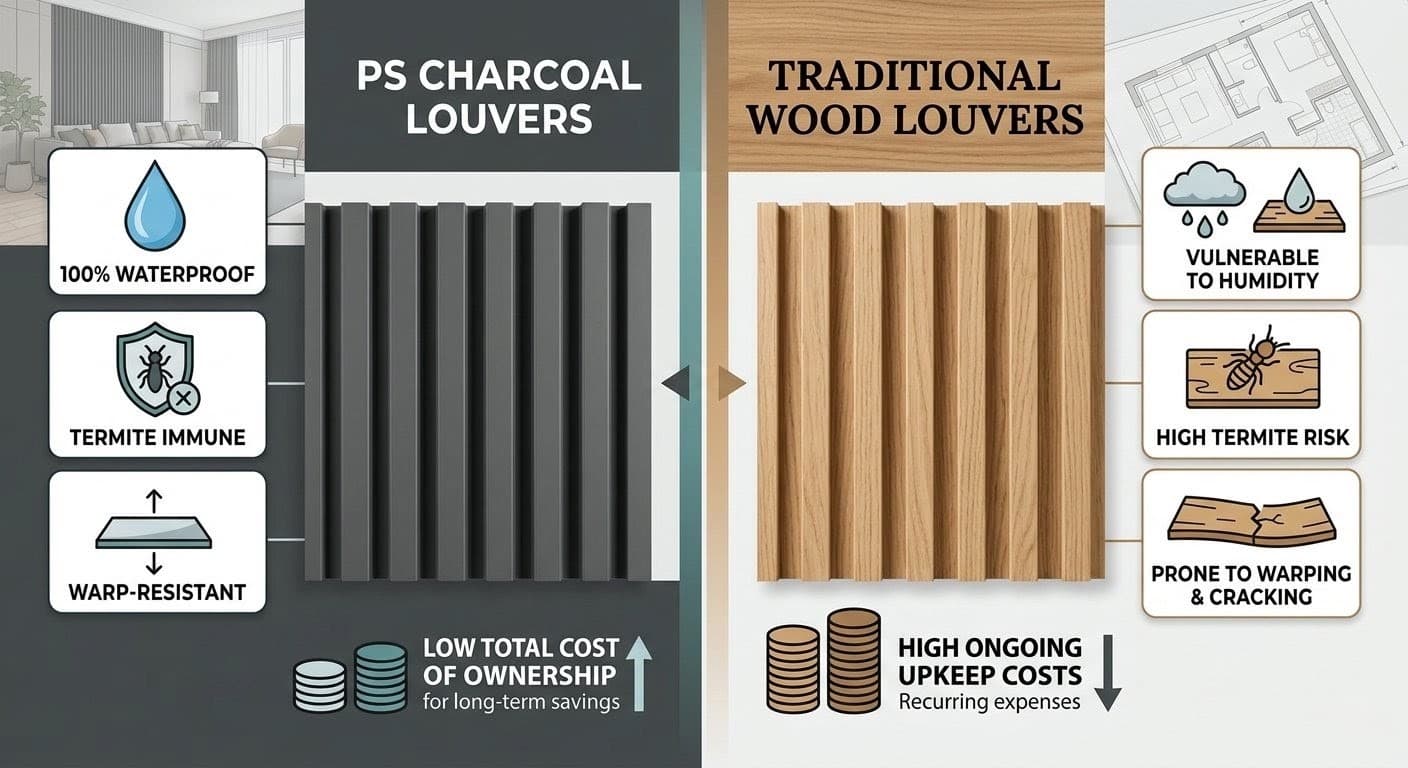
Fluted walls, accent panels, and textured room dividers have become defining signatures of modern architectural and interior design. For years, solid hardwood was the go-to material for achieving warm, tactile slatted surfaces. However, natural timber comes with well-known trade-offs—including swelling in humid weather, termite risks, and recurring polish treatments.
Enter PS (Polystyrene) Charcoal Louvers. Engineered to deliver the rich depth and premium aesthetic of natural wood without its physical liabilities, high-density polystyrene louvers are rapidly becoming the preferred choice for architects, interior designers, and homeowners.
Here is how PS charcoal louvers stack up against traditional wooden louvers across the three key factors that matter most: Durability, Maintenance, and Cost.
1. Durability & Environmental Resistance
When evaluating wall cladding, structural stability over time is critical.
- 100% Waterproof: PS charcoal louvers do not absorb moisture. Unlike natural timber, which swells, rots, or delaminates when exposed to humidity, PS panels remain entirely unaffected by water seepage, steam, or high dampness. They can even be installed in utility areas, kitchens, and damp feature walls where solid wood would fail.
- Warp & Crack Resistance: Timber naturally expands and contracts with atmospheric changes, leading to unsightly warping, cupping, or surface cracking over seasonal shifts. High-density PS panels maintain strict dimensional stability regardless of humidity or temperature fluctuations.
- Termite & Pest Immunity: Being a synthetic polymer composite, PS charcoal louvers provide zero food value to wood-boring insects, termites, or fungal spores. Solid wood requires periodic chemical treatments to stay pest-free.
- Lightweight Structural Integrity: PS louvers offer high impact strength at a fraction of the weight of solid teak or hardwood. This reduces dead load on wall structures and makes ceiling-height installations significantly safer and easier.
2. Maintenance & Daily Upkeep
The true difference between materials often reveals itself two to three years after installation.
- Traditional Wood Louvers: Require ongoing labor. Natural wood must be sanded, re-stained, or re-varnished every 2 to 3 years to prevent fading and seal against moisture. Any moisture ingress beneath the finish can cause peeling or internal rot.
- PS Charcoal Louvers: Virtually zero maintenance. The color tones, charcoal stains, and micro-textures are integrated into the material during extrusion, eliminating the need for painting, staining, or polishing ever. Routine cleaning involves a simple wipe-down with a dry or damp microfiber cloth to remove surface dust.
3. Upfront Cost vs. Total Cost of Ownership
While material selection often starts with the initial price tag, long-term ROI tells a different story.
- Initial Material & Labor Expense: Premium natural hardwoods (like teak, oak, or walnut) carry high material costs, paired with skilled carpentry labor for shaping, sanding, and on-site finishing. PS charcoal louvers are pre-finished and feature interlocking edge profiles, allowing rapid installation using standard adhesives and hidden pin nails—dramatically reducing labor costs and installation timelines.
- 10-Year Lifecycle Value: Over a decade, traditional timber incurs continuous costs in wood polish, sealants, termite treatments, and potential replacement of warped slats. PS charcoal louvers incur zero recurring chemical or labor costs, making them significantly more economical over the product's lifespan.
Comparison at a Glance
| Feature / Metric | PS Charcoal Louvers | Traditional Wood Louvers |
|---|---|---|
| Moisture Resistance | 100% Waterproof & Damp-proof | Vulnerable to humidity & swelling |
| Termite Risk | Completely Immune | High risk; requires chemical treatment |
| Dimensional Stability | Will not warp, cup, or crack | Prone to expansion & distortion |
| Maintenance Need | Occasional wiping | Polishing/varnishing every 2–3 yrs |
| Weight | Lightweight; easy wall/ceiling load | Heavy; requires strong structural backing |
| Aesthetic Depth | High-definition grain & real wood tones | Organic natural grain (varies) |
| Long-Term Cost | Lower total cost of ownership | High ongoing upkeep costs |
The Verdict
If your project demands the authentic, one-of-a-kind variation of living timber and has a dedicated budget for ongoing maintenance, natural wood remains a timeless choice.
However, for modern residential and commercial spaces requiring flawless luxury aesthetics, rapid installation, and complete immunity to moisture, termites, and warping, PS Charcoal Louvers provide an unbeatable, future-proof alternative. You achieve the high-end fluted look—without any of the traditional timber headaches.
